
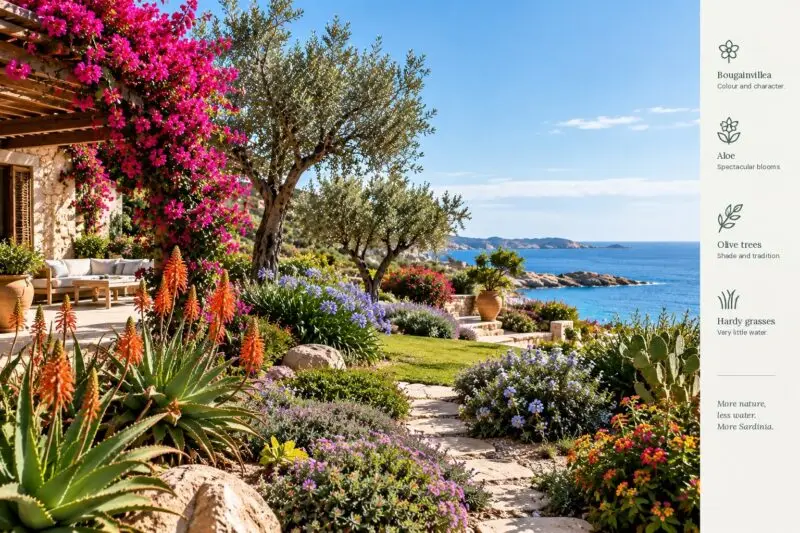
In Sardinia, a garden shouldn’t fight the climate, it should work with it. Intense sun, long summers, wind, salt spray and dry spells: for a home on the coast, choosing the right plants means an outdoor space that looks beautiful all year round, with little water and little maintenance.
Why the garden matters for the value of a seaside home
In our climate the garden is not an extra: it is an additional room, lived in from March to November and often in winter too. Anyone looking for a home on the coast, especially buyers from abroad, looks closely at the outdoor space: where to eat, where to find shade, how much it costs to maintain.
A well-kept garden that suits the landscape and is easy to manage immediately signals quality. A scorched lawn or plants struggling with salt, on the other hand, suggest costs and work ahead. For owners who use the home only a few months a year, low maintenance becomes real added value.
The golden rule: choose Mediterranean plants
The secret is not giving up on greenery, but choosing the right greenery. Once well established, drought-tolerant plants need far less irrigation than a traditional lawn or species from more humid climates. On the coast, however, drought is only half the problem: the other half is salt.
Front line or second line? Salt changes everything
Salt-laden wind, sandy soil and sometimes slightly brackish well water test even the toughest plants. That is why it pays to think in zones:
🌊 Front line: direct exposure to sea wind
Here you need species from the coastal Mediterranean scrub, which have always lived with salt: mastic (lentisk), helichrysum, myrtle, pittosporum, tamarisk, saltbush (Atriplex halimus), shrubby germander, rosemary and sea lavender, together with agaves and aloes. They form hedges and windbreaks that protect everything behind them.
🌿 Second line: areas sheltered by walls, hedges or the house
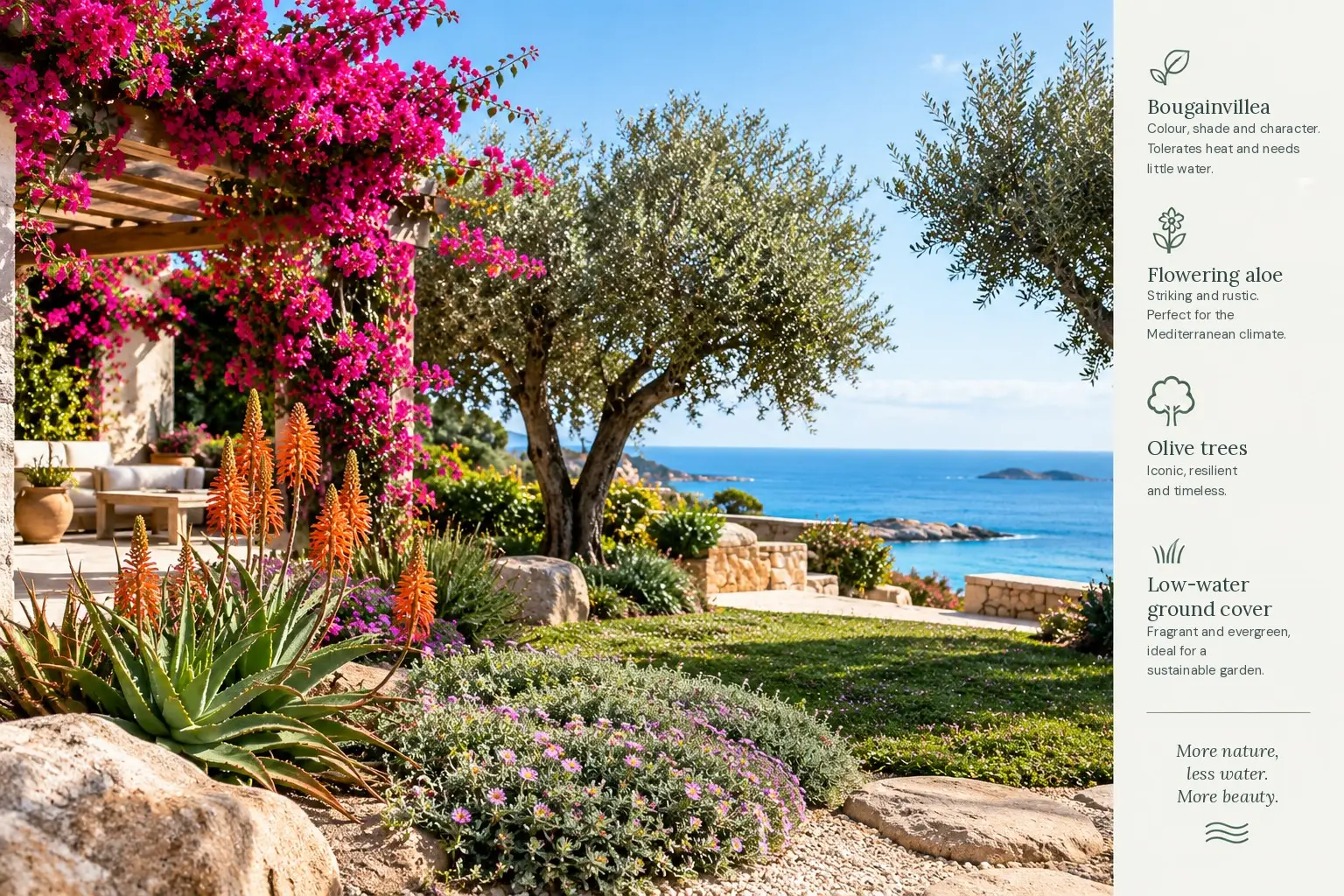
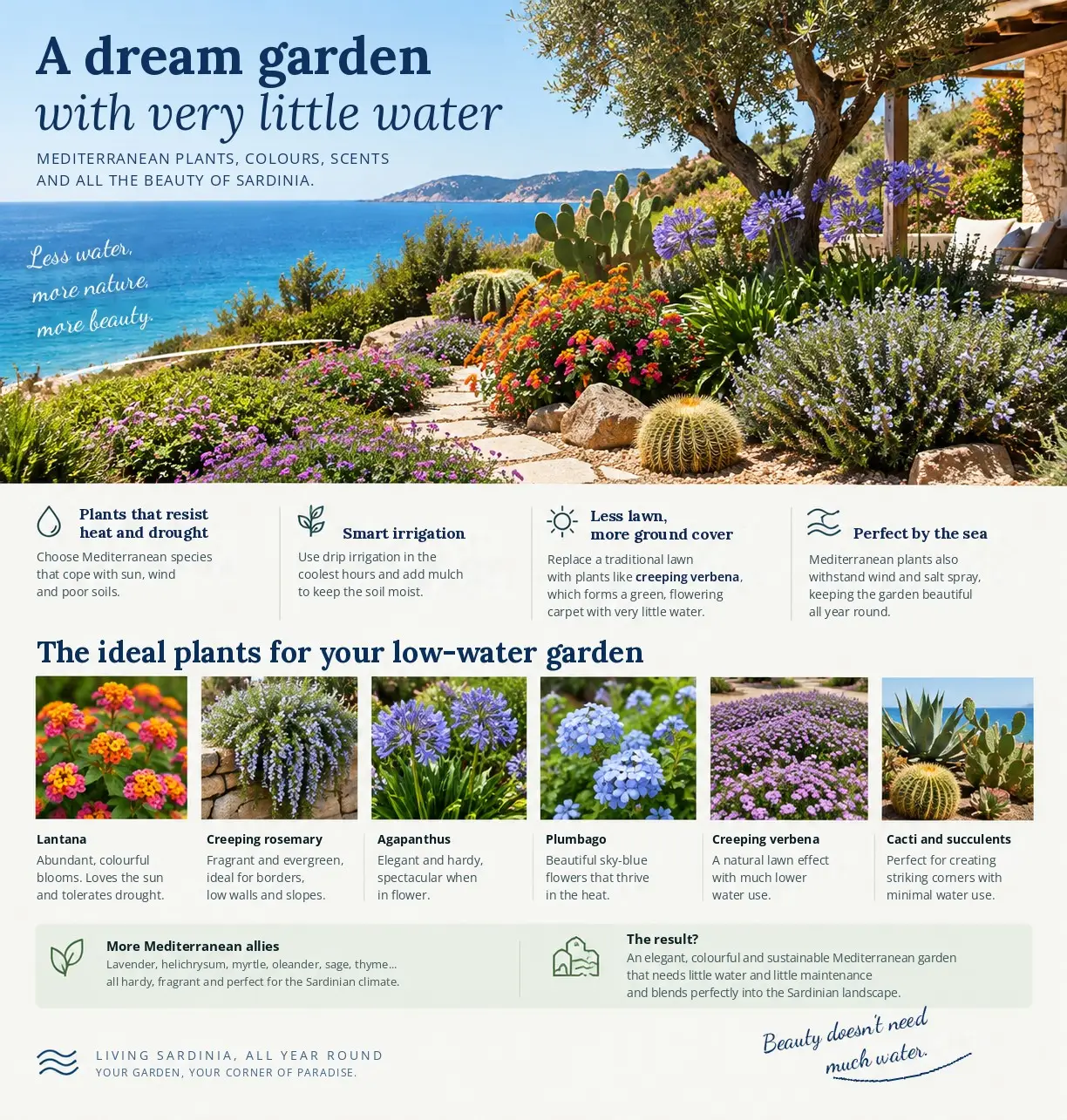
Away from direct salt spray, the most eye-catching plants can show their best: bougainvillea, lantana, plumbago, agapanthus, creeping verbena and olive trees.
🌺 Sheltered, irrigated corners: the most demanding plants
Hibiscus and jacaranda offer spectacular blooms, but suffer from salt and drought. They are best placed in strategic spots, protected from the wind and where a little more water can be provided.
Avoid: the Hottentot fig (Carpobrotus), widely used on coasts because it grows anywhere, is an invasive species that smothers Sardinia’s native dune flora. To cover slopes and sandy ground, choose creeping rosemary, helichrysum or other Mediterranean ground cover instead.
Plants for a low-water coastal garden
| Plant | Water | Salt spray | Best for |
|---|---|---|---|
| Mastic, helichrysum, pittosporum, tamarisk | Minimal | Excellent | Front-line windbreak hedges |
| Aloe, agave and succulents | Minimal | Good | Rock gardens, very sunny spots |
| Creeping rosemary | Minimal | Good | Low walls, slopes, fragrant borders |
| Olive tree | Minimal | Good | Focal point, natural shade |
| Oleander | Low | Good | Hedges and screening (toxic if ingested) |
| Lantana | Minimal | Moderate | Splashes of colour in full sun |
| Bougainvillea | Minimal | Moderate | Pergolas, walls, fences |
| Agapanthus | Low / moderate | Moderate | Pathways, flowering groups |
| Plumbago | Low / moderate | Moderate | Drifts of sky-blue flowers |
| Creeping verbena | Low | Moderate | Lawn alternative |
| Hibiscus, jacaranda | Moderate | Poor | Sheltered, irrigated corners |
What about the lawn? You don’t need a uniform green carpet. Combining ground cover, gravel, stone and Mediterranean beds gives a more natural and sophisticated result. If you still want a grassed area, there are turf species such as Paspalum vaginatum (seashore paspalum) that cope well with heat and slightly brackish water.
Watch the video: a Mediterranean garden that lives on little water
Small measures, big difference
- Drip irrigation, with water delivered to the base of the plants and never onto the leaves, especially if well water is brackish.
- Water during the coolest hours, early morning or evening.
- Mulching with bark, gravel or volcanic lapilli to limit evaporation.
- Well-drained soil, because waterlogging is the enemy of Mediterranean plants.
- Plants grouped by water needs, so you only irrigate where it’s needed.
- Windbreak hedges and dry-stone walls to create areas sheltered from salt spray.
- A fresh-water rinse of the leaves of more delicate plants after the strongest sea storms.

Enjoying the outdoors from indoors: bioclimatic pergolas and VEPA glass enclosures
A beautiful garden gains even more value when you can enjoy it in every season. Two solutions are changing the way people live in coastal homes.
☀️ Bioclimatic pergolas
Roofs with adjustable louvres that control light, shade and ventilation: open on mild days, closed against the August sun or a sudden downpour. They turn terraces and patios into living spaces for most of the year.
🪟 VEPA glass enclosures
VEPA (vetrate panoramiche amovibili) are removable, fully transparent panoramic glass panels that enclose loggias, balconies and porticoes without blocking the view. They shelter you from wind and salt spray and let you enjoy the garden and the sea even in winter, as if they were part of the living room.
What the regulations say. Under Italy’s “Salva Casa” Decree (Decree-Law 69/2024, converted by Law 105/2024), bioclimatic pergolas and VEPA fall under “edilizia libera” (works that need no building permit), subject to specific conditions: they must not create permanently enclosed spaces or new volume, and VEPA cannot be installed on porticoes open to public use or facing public areas.
Take care on the coast, though: properties within 300 metres of the shoreline fall within a landscape protection zone. “No building permit” does not mean “no authorisation at all”: landscape approval (autorizzazione paesaggistica) may still be required, as well as compliance with condominium rules and distance requirements. Before installing, always have the property checked by a qualified technician.
A practical tip: near the sea, choose aluminium structures with specific marine-grade treatments and stainless steel components. Salt is aggressive on materials too, not just on plants.
The real luxury? A garden that is beautiful and easy to live with
A seaside home doesn’t need a perfect lawn that demands water every day. It can have something far more beautiful: a Mediterranean garden, fragrant, colourful and natural, designed to withstand sun and salt and to need little maintenance. With a well-designed pergola or glass enclosure, it becomes a space to enjoy twelve months a year.
Because a garden also tells the story of a home’s style, and supports its value over time.
More nature. Less water. More Sardinia.
Want to enhance your seaside home?
Whether you are thinking of selling, buying, or simply want to know what your property in the area of Cagliari on the coast between Quartu Sant’Elena and Villasimius is worth, let’s talk. I’ll help you understand which outdoor improvements can make a real difference.
Valeria Pintus, Ajò Immobiliare · +39 340 966 5468 · ajo.casa
The information on regulations is general in nature and does not replace an assessment of the specific property by a qualified technician.